We detected that you are browsing from
Choose where you’d like to go:
We detected that you are browsing from
Choose where you’d like to go:
Explore essential knowledge, engineering insights and practical guides designed to help you get the most from every journey.
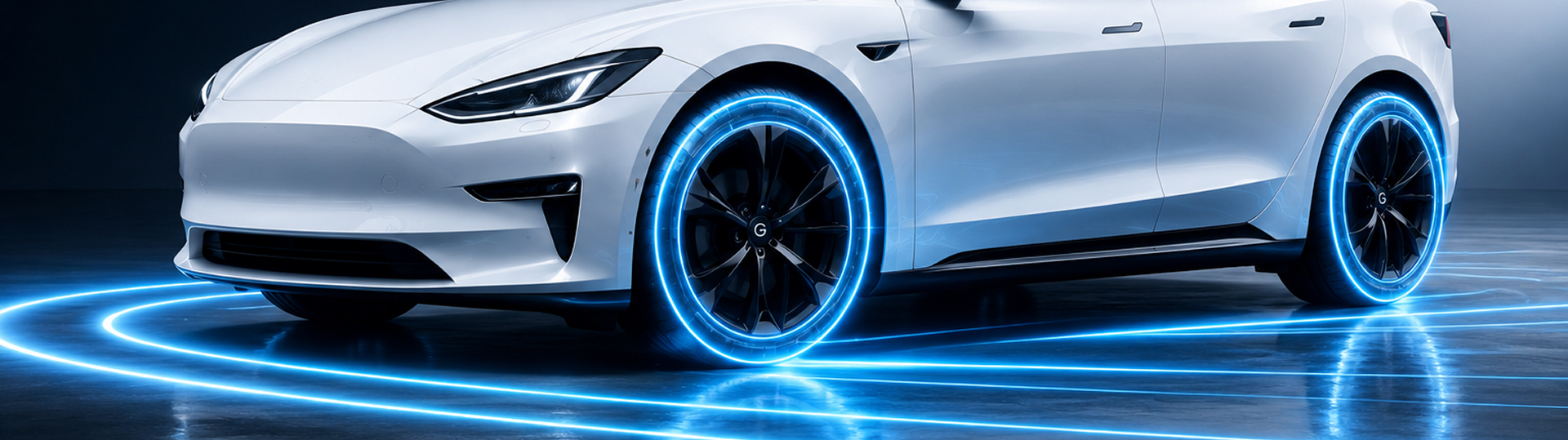
Tires can affect EV range because rolling resistance determines how much energy is lost as a tire deforms while rolling. Lower rolling resistance can reduce energy consumption and support driving range, but the actual effect on range varies with the tire, vehicle, tire pressure, speed, temperature, road conditions and driving behavior.
For this reason, there is no single percentage by which tires affect the range of every EV.
As a tire rolls, its tread and sidewall continuously deform as they enter and leave the road contact patch. Some energy is lost during this process.
The greater the rolling resistance, the more energy the vehicle needs to maintain motion. In an EV, that energy ultimately comes from the battery.
However, an EV tire cannot be engineered for low rolling resistance alone. Tire engineers have to balance:
• Energy efficiency
• Wet grip
• Braking
• Handling
• Durability
• Noise & comfort
This engineering balance is particularly important because reducing one characteristic can potentially affect another.
Tire-related energy consumption is influenced by several factors:
• Tire compound: Material formulation affects deformation and energy loss.
• Tire construction: Internal structure influences stiffness, load support and deformation.
• Tread and profile: Pattern and tire geometry influence the contact patch and rolling behavior.
• Inflation pressure: Underinflation can increase deformation and rolling resistance.
• Vehicle load: Additional load changes how the tire deforms.
• Temperature and road conditions: Both can alter rolling resistance.
A strong real-world example is Giti's OE development for the all-electric BMW iX1 and BMW iX2.
Giti developed the GitiSynergy H3 in 245/40 R20 99Y XL specifically for these vehicles. It achieves the highest EU Rolling Resistance label rating of A while also being engineered to meet BMW requirements for handling, noise, wear life and sustainability. The tire carries the BMW * marking, signifying BMW Group homologation in accordance with its OE specifications.
The GitiSynergy H2 became Giti's first European EV OE fitment when selected for the Volkswagen ID. Buzz.
Its tread compound was developed to achieve significantly reduced rolling resistance without compromising wear, wet and dry braking or handling. The OE sizes are 235/60 R18 front and 255/55 R18 rear.
Tires affect EV range primarily through rolling resistance, but there is no universal percentage impact. The objective of EV tire engineering is to reduce energy loss while maintaining the grip, braking, handling and durability required by the vehicle.
 Back To Top


